Sophie

Picking Daisies

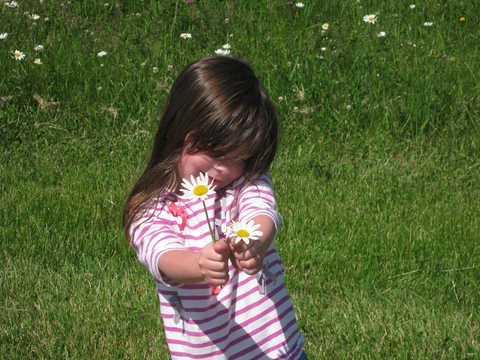
Every spring I look forward to the small field of daisies in my parents’ yard. Early May Nini brought out three Mason jars and the kids delighted in walking in the field, picking flowers and making bouquets. James struggled with the picking. He’d find a daisy, grasp it, pull and then yell (so loudly) “Help, Nini! HELP!” until my mom would come over and pick it for him. For more than a week our house was filled with the white and yellow flowers, a flower that always reminds me of home.

“The splendor of the rose and the whiteness of the lily do not rob the little violet of its scent nor the daisy of its simple charm. If every tiny flower wanted to be a rose, spring would lose its loveliness.” —Therese of Lisieux

A School Year

Sophie’s first day of preschool, September 6, 2011

She was so excited.

Sophie’s last day of preschool, May 23, 2012

Her teachers said she was so quiet, her last day. I think she was sad. She’s still telling everyone she’s just on spring break. I imagine she’ll appreciate summers more in her later years.

“Time is what prevents everything from happening at once.” —John Archibald Wheeler

“They Grow Up So Fast”

Turns out I’ve managed to screw up Sophie’s sense of time.

After celebrating Andy’s birthday with us, my parents took Sophie back to their house to spend the night. Sophie was watching Andy and my dad install her car seat in my parents’ car. Andy later told me that he and Sophie were talking about when she would be old enough to drive. He told her she had to be 16, and that 16 is 4, how old she is now, plus 4, which is 8, plus 4, which is 12, plus another 4, which is (finally) 16. She thought about this, and then said it would be even longer for the boys. Andy agreed, because the boys are only 2. “And because it’s going to take longer for them than it will for me,” Sophie said. “Why?” Andy asked. “Because Mommy said I’m growing up too fast.”

“An unhurried sense of time is in itself a form of wealth.” —Bonnie Friedman

I Spy

A few days ago Sophie, Owen, James and Colleen received an e-mail from my mom—an I Spy game (can you spot the bumblebee?). I love that our children are able to play “I Spy” virtually, in my mom’s lavender garden. Now if only e-mail included scent.

“I spy with my little eye …”

Pinkeye

Somehow Sophie went from runny nose and cough to runny nose, cough, high fever and (a lot of) yellow gunk coming out of her eye. (This in addition to other runny noses, fevers and maybe-pinkeyes in the house right now.) Cue the Saturday evening call to the doctor and antibiotics prescribed over the phone. We made the call close to her bedtime, so by the time the prescription was actually called in, filled and picked up, it was close to 10pm. Sophie was miserable at this point, not feeling well and exhausted.

I tore off the stapled instructions from the paper prescription bag.

And read this:

(Note, Sophie hates water in her eyes, hates it. I’m talking, screams-in-the-shower-won’t-dunk-her-head-in-a-pool-can’t-stand-to-be-splashed hates it.)

TO USE THIS MEDICINE, first wash your hands. Tilt your head back and, with your index finger, pull the lower eyelid away from the eye to form a pouch. Drop the prescribed number of drops of medicine into the pouch and gently close your eyes. Do not blink and keep your eyes closed for 1 or 2 minutes. Do not rub the eye. Place one finger at the corner of the eye near the nose and apply gently pressure … This will prevent the medicine around your eye from draining away from the eye. Remove excess medicine around your eye with a clean tissue, being careful not to touch your eye. Wash your hands to remove any medicine that may be on them.

Except that we weren’t doing this to ourselves. Rather we were doing this to our 4-year-old—our exhausted, sick 4-year-old who hates anything in or close to her eyes.

I looked in the prescription bag to see if there was another medicine that would knock Sophie unconscious just long enough for us to do this to her.

The bag was empty.

We decided to be straight up with her, tell her exactly what we were going to do, what was going to happen and ask her if she had any questions.

She looked at us like we were the worst parents on this planet and buried her head (and self, really) into my pillow.

We got the drops in. It involved (not necessarily in this order) explanation, pleading, bribing, begging, pinning down, pinning open, screaming, crying, gummy worm eating.

Oh, and we get to do this three times a day.

For seven days.

“A Spoonful of sugar helps the medicine go down
The medicine go down-wown
The medicine go down
Just a spoonful of sugar helps the medicine go down
In a most delightful way.” —Mary Poppins

Work

Sophie knows that Andy goes to work every day. And that he works on a computer every day. And that his work earns our family money every day.

She attends a Montessori preschool and the word “work” is used often. So she also understands work as an activity she pulls off of a shelf and takes to a small rug to complete.

But I don’t think she quite understands my work. She certainly doesn’t consider the stay-at-home-mom work I do every day as work. And I don’t want her to think of my taking care of her as “work,” even though every once in awhile I secretly would like her to know that the reason she has food every day and clean clothes every day and a bath (most) days is because of the “work” Andy and I do.

But I also have other work, freelance editing and writing work. I’ve tried to explain this work to her. But she simply thinks (and tells people) that my job is playing on the computer. Lately, however, my editing work has been a bit more old-fashioned—I’ve been editing on paper, with a red pen. And having grown tired of all-nighters (something I was able to do quite easily in college, but has become increasingly hard for me the older I get), I’ve been trying to do more of this work during the day, while the boys nap. Sophie is intrigued by this work. And after hearing me say “no” for the 10th time to her request to “help” me with my work (which invariably involves drawing a flower on the pages I’m editing, something I’m sure my editors love) she gets out her own work.

We have never pushed workbooks or flashcards or the like on Sophie, thinking that she will have enough of that in her lifetime. But we’ve also discovered that she loves workbooks. Loves them. She loves tracing letters and doing simple addition and subtraction and finding opposites and differentiating between big and small. Of course, she loves playing with her plastic princess figurines and wooden castle and ponies and dolls much more. But when she sees me doing my work, she insists on doing her work. Hence the picture above (and yes, she’s wearing her bathing suit and sporting a train tattoo on her arm).

She concentrates so hard on this work. And she zips through workbooks so quickly. Grandma and Paw Paw brought her two this weekend, and she’s almost through both of them.

I love that she loves her work. I love that she’s eager to learn. I love the way she wrinkles her brow and purses her lip when she’s trying to think something through. But I also worry. I got As and Bs (and some Cs) in school, but unlike some people, I had to work for the grades—really work for them. And I stressed over my work. This was not my parents’ doing. In fact, they once approached a parent-teacher conference with concern over the amount of time I was spending, worrying about homework. As such, for the rest of the year, my teacher would put a time limit on the top of all my homework assignments, big, red, circled. Once the time limit was up, I had to stop, no matter how unfinished, how imperfect. At first, this additional hurtle worried me to no end. But in the end, it was one of the greatest gifts ever given to me.

I think the best kind of work is work that doesn’t feel like work. I feel those who live that life are lucky. I try to live that life, with caring for my children and my other work, my writing and editing. (But trust me, when it’s 2am and I still have hours of editing left, I often don’t feel lucky.) I also admire those who find joy in work I love to hate—laundry, scrubbing bathrooms, weeding, even cooking. I strive to find joy, fulfillment and contentment in these everyday chores. Some days I do, some days I don’t—even when I remind myself to be grateful that I have a yard to weed, bathrooms to scrub, clothes to wash and good food to cook.

But for now, it’s clear Sophie finds great joy in her work, tracing letters, X’ing big stars and circling little stars, matching. So I let her be. Let her grow. Let her learn. And I hope that passion for work stays with her always, not in an every-day always, but in a big-picture always. And perhaps most, I hope her grownup work is work she loves just as much as her childhood work. Work she looks forward to doing, enjoys doing, loves having done. I realize this requires a combination of skill, luck and attitude, but it’s something I so desperately want for her, for all my children, for everyone.

“Nothing is really work unless you would rather be doing something else.” —James Matthew Barrie

Water and Lavender

A couple weeks ago, Sophie’s room was a mess. (Actually, Sophie’s room always seems to be a mess as of late but I’m talking about one particular day in which it was a mess, a couple weeks ago.) I had to shower. So I asked her to clean her room while I showered.

Halfway through my shower she came into the bathroom (little people coming into the bathroom while I shower is perfectly normal to me now), climbed up on the stool and filled a plastic spray bottle with water. I remembered seeing that spray bottle already full, only five minutes before.

I stuck my head outside the plastic shower curtain, soap still in my hair.

“Sophie, what are you doing?” I asked.

“Cleaning my room,” she said.

“Why do you need water in a spray bottle to clean your room? And what happened to all the water that was in the spray bottle before?” I asked.

“I told you! I’m cleaning my room!” she said.

I really wanted to finish my shower. I hate having to grab a towel, get out, figure out why someone is crying/yelling/not making any noise mid-shower. I hate that water gets everywhere when I do that, I hate how shampoo drips in my eyes when I do that and I hate feeling hot and then cold and then hot again when I do that.

So I (foolishly) ignored the situation.

When I was done with my shower and properly dried off, I walked into Sophie’s room. I felt my bare feet squish into carpet soaked with water. Nothing had been picked up. And sprigs of dried lavender were scattered all over the floor.

“Why is the carpet wet?” I asked (clearly she had sprayed every inch of it with her spray bottle, but I wanted to know why). “And why is there lavender everywhere? And why haven’t you cleaned at all?”

“I have been cleaning!” she said. “The whole time! I cleaned the carpet with my spray bottle. And spread lavender everywhere to make it smell good. That’s cleaning.”

I thought of all my lavender-scented cleaning products, and how she loves to sniff them when I’m using them. I sighed. The carpet eventually dried. I helped her pick up her toys. And I’m still, occasionally, finding little sprigs for lavender in her room.

“Love is the thing that enables a woman to sing while she mops up the floor after her husband has walked across it in his barn boots.” —Hoosier Farmer

A Bean Plant

Some days I yearn for simplicity. The uncomplicated. The untroublesome. I stand in the kitchen for an entire minute, hands to my nose, simply taking in their scent after peeling a clementine. I watch the cardinals flit about our yard, branch to patio to chair to branch to deck and back to branch, looking for food, looking for items for which to build a nest. I stand in the shower and let my hands get hot from the water and then I place my palms over my eyes, feeling their warmth.

Often, I have to actively remove myself from the complicated, purposefully seeking out the simple. But some days, it’s gifted.

Today’s gift was a bean plant. From Sophie. It’s the classic preschool project—a bean that sprouts in the confines of a wet paper towel and then grows, thanks to small hands, a styrofoam cup, a handful of dirt, a sunny classroom windowsill, a watchful teacher and daily water.

I stared at the plant for a long time today. It had grown so large, in that tiny cup. I thought about the number of small plants that have been started from seed, in styrofoam cups, in classrooms around the world this spring. And last spring. And the many springs before.

There was a lesson with it, of course. A simple lesson. A good lesson.

I loved that bean plant today. I needed that bean plant today. Just like some days I need the smell of orange peel on my skin, reminding me that even on life’s more complicated days, there’s still, always, the simple.

“I go about looking at horses and cattle.  They eat grass, make love, work when they have to, bear their young.  I am sick with envy of them.” —Sherwood Anderson

What the Girl at the Park Has Taught Me

Last summer I wrote about a girl I met at a park, here. Today the essay is featured on The Huffington Post, here.

Softball has started up again, and a couple weeks ago I took the children to one of Andy’s early games. As usual, we spent more time at the playground than we did on the bleachers, watching the game (thankfully, Andy is understanding about this). The girl at the park was there again, a little taller, a little wiser—just like Sophie. I believe she’s often there. She and Sophie played again, raced again, played tag again, had fun again.

That night I decided to straight-up ask Sophie about the girl’s missing arm. I felt like last summer I sort of glossed over it and I have long wondered if that was the appropriate thing to do. So I asked her about the girl at the park. I asked her about the girl’s missing arm.

Sophie didn’t believe me. She said it wasn’t missing. “She was hiding it,” Sophie said, “behind her back.”

My heart broke a little bit when she said this. It was as if she couldn’t accept the fact that someone might be missing something as important as an arm.

“No, Sophie.” I said. “She wasn’t hiding it behind her back. She only has one arm. But that’s OK. It doesn’t hurt her. And did you see all the things she was doing on the playground? She climbed everything you climbed. She ran just like all the other kids ran. When you hugged her, she hugged you back. She’s just like you and me, except she doesn’t have an arm. And some people only have one arm.”

Sophie shook her head. “That’s not true!” she said. “She was just hiding it!”

I so wanted to tell her she was right. I so wanted to keep her in the bubble of innocence she—we—had built around her. But I knew I couldn’t. That I shouldn’t.

“No, Sophie,” I said. “I’m telling the truth. She wasn’t hiding her arm. She only had one arm.”

And then, I kept going.

“Some people,” I said, “don’t have any arms at all. And some people are missing a leg. Or both legs.”

Sophie, on the verge of tears asked, “Then how do they walk?”

I told her about legs that doctors can make. I told her about wheelchairs. I told her about all the wonderful things medicine and society has done to help people.

And still, I kept going. I told her that some people don’t have an eye, or they’re missing fingers or maybe some toes.

I kept going, not noticing Sophie’s quivering lip, not paying attention to the little voice in my brain saying, STOP! YOU ARE TOTALLY FREAKING HER OUT!, not realizing that in her mind, she was probably picturing one single person without arms, legs, ears, eyes and a nose.

She burst into tears.

“It’s not true, Mommy! That doesn’t really happen! Stop saying that!”

Andy just looked at me, wide eyed, wondering what in the world I was doing to our daughter.

I then wondered why mandatory parenting classes for these types of conversations don’t exist.

I calmed Sophie down. I reminded her all the wonderful things the girl at the park was able to do. I assured her that most people who are missing something are missing only one thing—not all the things I listed. But I kept pushing. I wanted to make sure she believed that, for some people, this was their reality. And that missing these parts didn’t make them less of a person—rather more times than not people living life missing something on the outside gained a lot more on the inside—courage, determination, compassion. I felt like it was time she wasn’t so oblivious. I wanted her to know that if she saw things she had questions about, that she could talk to us. I needed her to know that there are hardships in life, hardships beyond me saying “no” to dessert after a poorly eaten dinner.

But it was past her bedtime. She was visibly shaken, her cheeks tear-stained. Andy insisted I stop. We put her to bed. I so wanted to bring it up again, to talk about it some more, but I bit my tongue. Another time, I thought.

I still don’t know what she thinks. Does she still really believe the girl was hiding her arm behind her back? Or did my words get through to her? To find out, I know I need to bring it up again. I think this, with a heavy sigh.

The few comments I’ve received on The Huffington Post have made me realize something else about myself and my family: I don’t do enough. I write. I remember. I’m grateful. I donate. I give money. But I don’t do enough. You can read readers’ comments to my essay here. (And I should note that I don’t associate the girl’s missing arm to poverty and I, honestly, don’t pretend to be privy to her economic situation—only that I simply wrote about what I saw.)

Here is the response I posted on the HuffPo site:

Thank you for your comments. You are so very right in action being as important as remembrance. We were given so many baby-related things when our children were born (and we still benefit from hand-me-downs from many people as our children grow). I’m thankful for that and continually try to pay that forward, as my children outgrow what’s been given to us. I used to volunteer as a mentor but gave that up once I had children, thinking I didn’t have enough time. But do I really not have enough time? I certainly have time to watch a TV show in the evening. I had time to write this. Your words have reminded me that awareness and donated items isn’t enough—more action is what equals more change. And now that my children are getting older (my daughter just turned 4) I love the idea about getting them involved, in hopes that throughout their lives they, too, won’t just remember the girl at the park but be inspired by the girl at the park—DO something about the girl at the park. So thank you.

So this is where I ask your help. What do you do? What organizations are you a part of that address poverty, specifically? How do you get your entire family involved so that the innocence bubble is not just replaced with sometimes-sad reality, but the idea that yes, this is the reality but we can change that reality. Because I want to help change it. I want my children to help change it. I think we have a responsibility to help change it.

The girl at the park has taught me so much. About me. About how my children view the world. About our world. And I think doing something is the best way I can thank her. For it is good to be grateful, yes. But it’s much better to give someone else something to be grateful about.

“Seldom do people discern
Eloquence under a threadbare cloak.” —Juvenal

We Are All OK

Recently Sophie has enjoyed playing upstairs in her bedroom or our teeny tiny playroom, by herself. This is both weird and wonderful for me, although I admit, when she’s up there for a couple hours, I find myself missing her. But I know I need to respect her alone time.

When I’m downstairs with the boys, I’ll often yell up, “Sophie! Are you OK?” And she’ll yell back “Yes!” If I do this too often, her “Yes!” becomes “Yes, Mom! I’m OK!” (in a completely different tone).

Owen has picked up on this. His favorite thing to do this week is stand at the bottom of the stairs and yell, as loud as he can, “Sophie! Are you OK?” Sophie humors him the first five times, by answering politely. Once tired of it, she yells, “Owen! I’m OK! Stop asking me if I’m OK!” A minute later Owen is yelling up the stairs, “Sophie, are you OK?”

I tell Sophie to ignore him. I reassure Owen that Sophie is, indeed, OK. Still, Sophie responds every time, more and more exasperated.

I know. This is my fault.

But I sort of love it.

“Always end the name of your child with a vowel, so that when you yell the name will carry.” —Bill Cosby