kara

On Criticism

Yesterday I couldn’t wait for my Motherlode essay to be posted. But today, with comments that include the words “maudlin,” “trite,” “annoying” and “over the top,” I simply wanted the editor to post something else already so maybe the comments would stop.

This is not a post seeking praise. I was overwhelmed with kind words from family, friends and via Facebook (thank you, for those). This is a post about learning how to write honestly but in a way that anticipates—and therefore addresses—possible criticism. And also, dealing with inevitable criticism that comes no matter what you write. And finally, deciding if it’s even worth it to write, knowing the type of criticism you’ll receive.

A lot of the criticism I received on Motherlode was in response to my not letting Sophie choose her own backpack. Perhaps ironically, she did choose her own (which, looking back, I should have made more clear in my essay). I wanted her to use my old preschool one, the elephant one my mom made. And what a lovely ending that would have been to my piece! Even Lisa Belkin, the editor of Motherlode, said via e-mail that she was rooting for the one my mom made. But I had already shown Sophie several backpacks online—the bee one, the pink monogrammed L.L. Bean one and another pink monogrammed one with a butterfly on it. She was obsessed with the pink butterfly one and she didn’t want anything to do with the elephant one (although, today she won’t take the elephant one off—go figure). And so I let her choose. By letting her choose I let her “take away” the perfect essay ending. And what was left was imperfect life—and an imperfect essay.

Of course, criticism can be a very good thing. I’m always concerned that my writing is too sappy, too Hallmark-esque. Perhaps it is. I did spend too much time researching that backpack. And it’s good to know that more than once she’s going to come home with wet clothes spoiling the inside of her bag. I, honestly, hadn’t thought about that. These comments, I appreciated. But the others, the ones that painted me as controlling, made me feel awful.

I wish I could tell everyone that my backpack search was done in the evening, after the children were in bed. I wish I could tell everyone how much time I’ve spent talking with Sophie about preschool, about the activities she’ll do, the friends she’ll meet, the books she’ll read, the things she’ll learn. I wish I could tell everyone that I understand there are far worse problems out there, that I was too obsessive, that I won’t cry in front of her on that first day (but maybe just a little, in the car, once she can no longer see me) and that I fully expect her artwork to come home wrinkled and torn, and that her backpack will get very, very dirty. In fact, I’d be worried if her backpack wasn’t all but destroyed by the end of the year.

I e-mailed Susan Shapiro (read her books, take her classes, she’s wonderful—you can learn more about her here), an author and writing instructor I worked with at Writer’s Digest magazine, and someone well-versed in the art of personal essays. She reminded me of the necessity of thick skin and said, “I always say if you want to be popular, write cookbooks.” She also reminded me of the importance of critique, if only to anticipate such criticism. And she’s right. I wrote my essay in about an hour and sent it off, without an outside reader, without letting it sit, without taking the time to truly think about people’s reactions—a novice writer’s mistake.

So this is what I’m struggling with: How do you write honestly, which means revealing all your idiosyncrasies, mistakes and faults, knowing you’ll get criticized, personally? And I don’t want to not read them. As a writer, red pen marks all over my pages are what have made me better. And as a parent, criticism has made me rethink how I handle things, do things and approach matters with my children. That said, it’s difficult not to feel the sting of judgement, the feeling that you’re failing your children in some way.

I love the personal essay. I have written them since elementary school. I love the column. I had one in my college newspaper. I love the blog. But am I ready for the personal to be so public? Is it worth it? I don’t know. Some days, yes. Other days, like today, I imagine a small cabin in the woods, with no Internet access, a Moleskin journal and pen my only outlet. But then, without outside opinion, how can one grow?

It’s a strange feeling today. Although not the print version, I can now say I’ve written for The New York Times. And while there’s excitement associated with that, I don’t know how graceful an entry it was.

But, it was an entry. Is it, though, an entry I want?

“Criticism is something we can avoid easily by saying nothing, doing nothing and being nothing.” —Aristotle
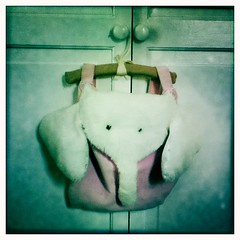
The New York Times Motherlode Guest Post: The Perfect Backpack

My HipstaPrint 0 (1) 2

The New York Times Motherlode blog is one of my favorites. Monday I read three essays on Motherlode (Daughter, Rising by Pam Allyn; Pay It Forward by Melissa T. Shultz and Silence is Golden by Karin Kasdin) about sending your child off to college. These essays made me think about Sophie, who will be starting preschool in September. And so I wrote an essay that night, and was thrilled when the editor of Motherlode asked to post it as a bookend to the essays listed above. You can read my essay here.

“Learning is a treasure that will follow its owner everywhere.” —Chinese proverb

The Girl at the Park

Andy had an early softball game tonight so the kids and I met him there to cheer him on. And by cheer him on I mean I tried to catch him at bat at least once while watching Sophie climb all over the bleachers and feeding tiny cut-up grapes (dinner) to the boys. Schmidt Field has a nice playground area, and Sophie knows this. I think Andy was only into his second inning when I finally gave in to Sophie’s pleading and took the kids to the swings.

We had almost reached the playground when a little girl who looked to be about Sophie’s age ran up to us. She said she liked our stroller. She helped me push it. She tried to unbuckle Owen while I was putting James in the swing. Once the boys were in the swings Sophie pushed James and the little girl pushed Owen. She wanted him to go high. I said not too high. She listened. I noticed she was staring at the boys’ shoes. She looked up at me. She said she liked them.

I looked down at her bare feet, caked with dirt, bits of long-ago red polish on her toenails. Her plaid green skort and halter top were soiled and stained—and not the kind of dirty that clothes get after a hard day’s play. But the kind of dirty that clothes get when they’re worn often and not washed. She was missing an arm and as such her halter top was skewed sideways so that one nipple was exposed. She had a wide scratch underneath her chin and a small one above her right eyebrow. A young boy walked past—someone she obviously knew—and she scowled at him and said, quietly, “dirty bastard.”

I thought so many things at that moment. I thought about her home life. I thought about those words, “dirty bastard.” I thought about her mother. I knew her mother wasn’t there because at one point a teenager slowly walked over and said “Be good or I’m going to tell your mama on you.” The little girl scowled at her, too. I thought about the girl’s scratches and hoped they were akin to the bruises covering Sophie’s legs—signs of playing hard rather than hard living. Looking at the girl, I should have felt blessed with all I have but instead I felt ridiculous. I thought of my Amy Butler diaper bag, the expensive Stride Rite tennis shoes and sandals on my children’s feet, Sophie’s Dora-branded, fancy flip-top water bottle, the smart phone in my purse. Although I am not rich, I felt spoiled. I felt sorry for her. I felt sorry, for all of us, living in a world in which so many have so much and so many have so little.

Sophie, of course, wasn’t thinking any of this. She was just delighted to have someone to play tag with. The girls chased each other all over the playground. They slid down the slide together, hand in hand. They climbed up the rope ladder together and sat on a platform together and at one point, when the little girl was elsewhere and Sophie was swinging and fell, the little girl ran over, concerned.

They were friends.

Eventually the little girl joined some teenagers and children at a picnic table. And Sophie found someone new to play with. But when it came time to leave, Sophie insisted on saying goodbye to her. So we walked over. And said goodbye. Sophie gave her a hug. The little girl hugged her back.

We left.

While walking back to Andy’s game, still in progress, I asked Sophie about the little girl. Sophie said she had fun playing tag with her. And then she paused. I braced myself. For questions about the little girl’s missing arm. The scratches. The dirty clothes. The words, “dirty bastard.” And then Sophie said, “She wasn’t wearing any shoes.”

“No,” I said. “She wasn’t.”

“Well, I don’t want to wear any shoes then, too.”

The little girl was admiring my boys’ sneakers. Sophie was admiring the little girl’s bare feet.

I love the way very young children so quickly friend each other, without thought to sex, class, race, popularity, appearance. I hope Sophie maintains that sense of openness, always. Especially during those oh-so-difficult middle-school years, when absurd things like a shirt’s brand name matters. (And, let’s be honest. For many of us, it still does.)

And while I loved their short friendship, I hated the fact that I met a child tonight who was forced to wear such dirty clothes. Who was missing an arm. Who knew the words “dirty bastard” at the age of 3. It made me hate what I have. And hate what she didn’t have. And hate that some—many—have much, much more. And then I hated all the hate that was flowing through me. And so I tried to be grateful. Grateful for the two girls’ smiles and laughter, for their quick friendship, for their goodbye hugs. Grateful for what I do have, even if it makes me feel spoiled. Grateful I had the childhood I did and grateful my children have the childhood they do. And grateful that, despite it all, a game of tag is still a game of tag—oblivious childhood fun.

I hope I remember that little girl always. Especially on days when I want. And I hope I can embrace Sophie’s attitude and instead, turn it around and wish for bare feet.

“There can be no keener revelation of a society’s soul than the way in which it treats its children.” —Nelson Mandela

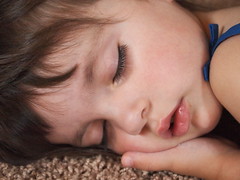
Beautiful Sleep

P7135467

“And if tonight my soul may find her peace
in sleep, and sink in good oblivion,
and in the morning wake like a new-opened flower
then I have been dipped again in God, and new-created.” —D.H. Lawrence

Climbing the Couch

P7255609

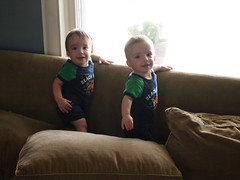
The boys can climb up on the couch now. Without help. They are extremely proud of this feat. (Sophie never did this.)

P7255613

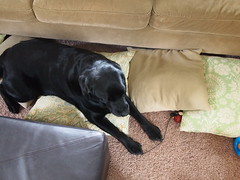
For a couple days I lined the front of the couch with pillows. But then Tucker just used them as a dog bed. So I stopped putting the pillows down figuring a couple falls and the boys would more quickly acknowledge edges. (To be fair there is carpet underneath …)

P7255610

P7255611

P7255612

P7255616

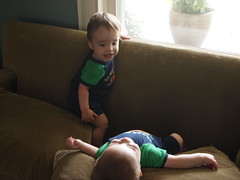
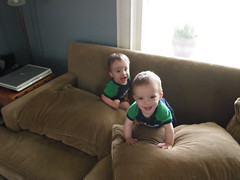
It is a.b.s.o.l.u.t.e. c.h.a.o.s. The boys fling themselves forward and backward and bury their heads in the cushions and climb up onto the window sill and over the arm of the couch to the end table where they bang the keys on Andy’s laptop, or sometimes pick them off or, if Andy’s smart and closes his laptop they then, simply, sit on top of it. Always there is the risk of someone falling off or toppling over an edge but short of gating the couch or removing it from the living room (both of which I’ve considered) there is nothing I can do but watch wide-eyed, jumping from one end to the other, arms reaching out, occasionally pulling in my breath loudly making the noise I so often make around these boys lately, the noise everyone laughs about.

P7265622

P7265628

P7265629

This is what it looks like from the outside. Sometimes, when our neighbors are taking walks, they slow down and stare as they push their strollers or pull their wagons or follow their child’s tricycle in front of our house thinking, I’m sure, thank God I’m not dealing with that. And even though it’s exhausting and frustrating (I love the look on Andy’s face in this picture) it’s also, often, a hilariously fun time—despite the bruises. So as much as I complain about that, really, I love that. OK, maybe not in the moment but definitely later, when everyone’s sleeping and I can’t help but smile when looking at their faces filled with such happiness, such joy.

“He who would learn to fly one day must first learn to stand and walk and run and climb and dance; one cannot fly into flying.” —Friedrich Nietzsche

Meeting Friends at Keehner Park


P7035373

P7035375

P7035377

P7035381

P7035384

P7035385

P7035386

P7035394

P7035409

P7035416

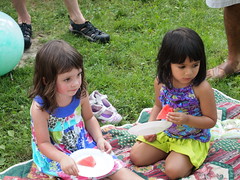
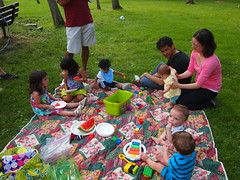
About a month ago my good friend Shruti was in town from Texas, along with her husband, Arun, and their two beautiful children, Rashmi and Naveen. So we, along with my good friend Aimee and her husband Jon, met at Keehner Park. Shruti’s brother Uday and his wife Alisa also were in town and so we were able to meet their beautiful daughter Sophia.

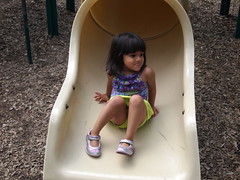
It was hot—oh, so hot—but we had a most enjoyable afternoon (even after Sophie had her first public accident, in the playground tunnel nonetheless—thankfully a ridge of plastic kept Rashmi from getting wet). We ate brownies and watermelon and exchanged belated birthday presents. The visit was too short. It always is.

“There is magic in long-distance friendships. They let you relate to other human beings in a way that goes beyond being physically together and is often more profound.” —Diana Cortes

A Switch

For months I’ve been wanting to switch my blog from Blogger to WordPress for many reasons and last night, all thanks to my husband, we did. Now it should be much easier to comment directly on my blog, which, according to those who are much better at building their readership than I am, is important. There are also buttons to share specific posts on Facebook, Twitter and reddit. If anything’s amiss, please let me know. (And a special thanks to Dara of Blessed Ink for the new logo and little house with the bee inside of it—I love it!) Also, if you have a blog that you update regularly and you would like me to include you in my link list, please let me know. I’m happy to add you!

Finally, thanks for reading. I imagine I would do this even if I were the only reader simply because I enjoy it so much, but I do appreciate the time spent listening to my babble as well as the comments. It’s a strange thing at times, to be so open so publicly. Especially when someone I don’t know well comments, in real life, about something I did or thought or felt three weeks ago. I think, How do they know that? And then I remember. I wrote about it. Because, you see, I have to write about it. On days when I’m feeling really grumpy I think about the last time I wrote an essay. If days have passed, I know what I need to do. It’s better than medicine, better than yoga, better than a glass of wine. And with feedback—good or bad—I feel heard, consoled, challenged and am made better. Especially when the days are long and my only other companions are three children—whom I love dearly—but whom I can’t converse with in the same manner as I do here. So thank you.

“Every improvement in communication makes the bore more terrible.” —Frank Moore Colby

The Knee Clutch—Again

P7185478

I took this picture of Owen mid-July and, looking back through my blog, realized I took almost the same picture of Sophie when she was about Owen’s age. (Owen, in general, is a little more frantic.) You can read about it here. Now, of course, it’s times two. (And some days, times three.)

“The quickest way for a parent to get a child’s attention is to sit down and look comfortable.” —Lane Olinghouse

Up Late for Apple Pie

Two nights ago Sophie helped us make an apple pie, which took an hour to cook. As such, she got to stay up past her bedtime because we decided it would be cruel to have her help make a pie, smell the pie while it’s cooking and then not be allowed to eat it. Because of bedtime. In the summer. Plus, Grandma and Paw Paw were visiting and grandparents always mean a bending of the rules.

By the time the pie cooled and she ate all her vanilla ice cream and didn’t even try the pie and then asked for more vanilla ice cream (we said no) it was 9:30pm. She curled up on the couch and asked for a blanket. I told her there were several nice warm blankets and quilts on her bed. And that it was time for bed.

She was done. It was well past her bedtime. We had visitors. She had been allowed to stay up late for dessert. She was in the mood to argue. We talked with her. Argued with her. Pleaded with her. And then, finally, I scooped her up.

Cradled in my arms, she made a round of quiet goodnights to everyone in the room. She protested once again.

“No.” I said. “It’s bedtime.”

She looked at me then, and in the softest voice said, “Do I have any other options?”

It was the sweetest and funniest thing. And how did she know that would get to me more than screaming, “I don’t want to go to bed!” Of course, I still put her to bed. As she had no other options. Which dismayed her greatly.

“Anyone who thinks the art of conversation is dead ought to tell a child to go to bed.” —Robert Gallagher

A Thank You Note from Colleen

We recently received the following e-mail:

Colleen Jennifer Rees-Four Months 061 (1)

Dear Aunt Kara and Uncle Andy,


Thank you for….

The clothes that keep me stylish.  (And lets me know what team to root for).
The diapers that keep my bum dry.
The socks that keep my toes warm.
The toys that keep me smiling.
And the advice that help Mom and Dad know what to do!

Love and miss you both!

Love, Colleen

I love that we’re able to pass these things on to Colleen (I’ve been saving them!) and am so grateful for everything that’s been passed down to us, from family, friends and even strangers.

Sometimes I wonder how—and why—the big box baby stores do so well when there are so many beautiful, useable and wearable used baby items out there. A summer goal of mine is to return bins, clothes, toys, bottles, Bumbos, a breast pump, books and many, many other baby-related things to their rightful owners—and pass along what isn’t wanted back to someone else who wants and needs them. 

Reuse and recycle—words so popular today yet so much a longtime natural part of raising children. Craigslist is a form of this. As are garage sales, Goodwill and consignment shops. It pains me to see toys that could easily be cleaned or repaired out on the curb for trash pick-up. An Exersaucer should last many, many children. As should links. And plastic cars. And baby dolls. And even items that get significant wear, like strollers.

I think about Bumbos. They’re easy to clean and practically indestructible. But they’re expensive. And they’re only used for about a year. They’ve been around for awhile (but are new enough that our parents wonder what they are and then comment on the fact that they never had—or needed—them when we were babies). And yet they’re on every registry I print out. One was on ours, when pregnant with Sophie. But shouldn’t there be enough used ones to go around for this year’s newborns? I understand new is nice and I appreciate the many new things we have. But I also wish I had sought out more used things when pregnant the first time around. It’s something I did much more of when pregnant with the boys. I had had several generous showers with Sophie. I didn’t want another shower for the boys. But yet I needed double of many things. Used was so easy to come by. And helpful, to us, financially, and to other parents, eager to create space in their basements and attics.

So pass along, don’t throw away. And if you are in need of something baby-related, do let me know. Now that the boys are 14 months, our attic is quickly filling with all those plastic things that made our lives so much easier those early months but are already no longer needed. And I’m eager to return the kindness that was given to us.


And yet, I confess: While I’m happy for the growth, it’s surprisingly hard to let so many of these things go. I remember when my parents gave Sophie that Reds T-shirt. And I remember the first game she wore it to, how she acted, what the weather was, how excited I was to take her. But even though I no longer have the shirt, I have the memories. And pictures. And little space. And no matter how loved, I believe a thing in use is better than a thing stored away, to what? Stumble across in a dusty box 10 years from now? No, I’d much rather see a picture of my niece in my inbox, ridiculously dressed up to show off what’s been given, what’s passed and what’s to come.


We are not to throw away those things which can benefit our neighbor. Goods are called good because they can be used for good: they are instruments for good, in the hands of those who use them properly.” —Clement of Alexandria