parenthood

Not Caring (For Just a Little Bit)

I responded to a friend’s comment on Facebook today with a story: Late this afternoon, close to dinner time, I just stopped. I pulled out my ipod and scrolled through e-mails at the worst possible time to take a break. Sophie was at her play kitchen stirring and mixing and transferring and patting real food (dry rice and pasta), which I had collected for her from the pantry while the boys napped—and never put away once the boys were up.

The boys, intrigued with what Sophie was doing, joined her. And promptly started throwing dry rice—everywhere. And breaking the angel hair pasta and throwing it—everywhere. Of course this was amid serious cooking, too, with Sophie barking orders and setting timers and pulling out wooden spoons and whisks and oven mitts. It was quite chaotic. Tucker joined in, eating more dry pasta than is probably healthy.

But I was done. The vision of the perfect mom—sitting on the couch reading a beloved story with three smiling children on her lap—a vision I hold dear, disappeared. I no longer cared. Owen, in particular, had been crying much of the afternoon. And for once, he was happy. They were all deliriously happy. And I was deliriously tired.

So I let them stir wildly, transfer poorly, spill and throw while I sat, hardly watching, catching up on non-important e-mail. If anyone walked into my house at this point, surely they would have thought I was crazy. For there was no lesson being taught. There was no scolding. There was no running after or picking up after. My dining room was being completely trashed and yet I was sitting, practically next to them, reading e-mail.

I simply let them go. And let myself go. They had fun. I had a small break. And you know what? Rice and pasta (if you position the hose just right) vacuums up quite nicely. So as long as they don’t think they can do that every time I pull real food out to play with, we’re good. I’m good, especially. And the longer I parent, the more I realize, sometimes letting go, stopping, taking a step back, not caring—even though the very definition of “mother” is “care”—is not only appropriate, but necessary.

“No matter how calmly you try to referee, parenting will eventually produce bizarre behavior, and I’m not talking about the kids.” —Bill Cosby

A Confession

Although it’s rare, every once in awhile, when the boys don’t really nap and Sophie’s in a mood, when 6pm feels very far away, when our house seems extraordinarily small, when I start feeling myself getting frustrated over the littlest of things, when I start thinking about how long 18 years really is, I drive. I load everyone up in the van with no intention of going anywhere specific, or doing anything in particular, except to drive, with all three children strapped into their carseats, unable to climb up onto anything, get into anything and hopefully, maybe, fall asleep.

There are many things wrong about this.

(1) My role as mother is to read to my children, take them on walks, provide them with finger paints, play hide-and-go-seek, push them on swings, build forts with them, produce puppet shows for them, and to tackle them and tickle them until they beg me to stop. A (good) mother, I would guess, does not strap their kids in their carseats, thinking of them not as safety devices but rather ingenious containment devices, wondering how many other seats in her house could benefit from a five-point harness system. And then think of the nannies she could hire off of patenting couches, for example, with just such a thing.

(2) This is not something a sort-of-vegetarian, recycler, former (shame-faced) cloth diaper-user does. I have no idea what the exact environmental impact is of me driving around aimlessly for two hours simply because I need a break but Earth, I’m sorry. You deserve better inhabitants than me.

(3) Gas is not cheap. Nor is the no-whip, non-fat grande pumpkin latte and three petite vanilla bean scones I bought at the drive-thru Starbucks all the way up in Kenwood, a good 25 minutes from my house.

(4) Time is invaluable to me these days. Days are meant for playing with my kids, feeding my kids and (trying) to occasionally do some laundry and run the dishwasher. Evenings are meant for bedtime routines and freelance work. So leaving my house in the middle of the afternoon for the sole purpose of achieving quiet means coming back home to a completely trashed kitchen, a pile of unfolded clean clothes, activities not done, snacks missed and a lonely dog.

This was my afternoon. The boys, who have given up their morning naps, slept for about 30 minutes after lunch before waking up screaming. I changed both their diapers and they did not stop screaming. I tried to play with them, dance with them, give them snacks, give them more milk, give them kisses—still, screaming. When they were done screaming at me they turned to each other, bopped toys on each other’s heads and, again, screamed. So much screaming. I e-mailed Andy. His response? “Drugs. Drug them. Tranquilizer dart from a distance.”

I looked at the boys. They looked at me. And screamed some more. So I scooped them up, barefoot, and took them to the van, with Sophie following me saying, “Where are we going? Where are we going?”

“Nowhere,” I said, promising her an unhealthy (a word that always prompts a smile from her) treat from a drive-thru (really, I should write a parenting book).

Two minutes into the car ride the boys were still wide awake, but calm. Happy, even. Sophie, on the other hand, dropped her princess doll and started begging, pleading me to pull over right now so I could get it for her. Two minutes later, she was asleep.

The boys stayed awake the entire time. And didn’t make a sound. Sophie got in a good nap, and I saved one of my petite scones for her, knowing the first thing she’d ask when she woke up was for her drive-thru treat. And I drove. And drove and drove and drove, sipping my latte, eating my scones, listening to NPR. And it was heavenly.

And now we’re home, and amazingly, everyone is pleasant. Even though we’re 20 minutes away from the dreaded witching hour.

I imagine many mothers handle afternoons like this differently. But if you had witnessed the screaming, the incessant screaming, you have to give me credit for something—at least when I left for the drive, I took them all with me.

“Parents are not interested in justice; they are interested in quiet.” —Bill Cosby

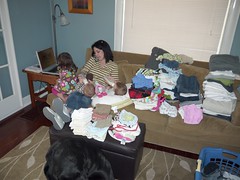
The Lure of the Open Laptop

P9065926

“The quickest way for a parent to get a child’s attention is to sit down and look comfortable.” —Lane Olinghouse

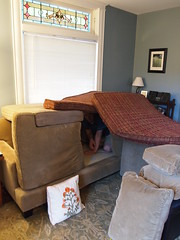
Daddy’s Rainy Day Fort

P6164848

The boys loved this fort (Sophie’s bedroom fort was too fragile for them to play in). And, if you look closely, you can see someone else who loved it, too.

“Growing old is mandatory; growing up is optional.” —Chili Davis

Filed Under Things I Don’t Want to Hear My Children Say

Me: “Oh, Sophie, we really need to cut your toenails!”

Sophie: “I know, Mom. I’ve been really bad about eating them lately.”

“Pretty much all the honest truth telling in the world is done by children.” —Oliver Wendell

Date Night, Past and Present

Tonight, while my parents are at Shaker Village celebrating their 35th wedding anniversary, Andy and I hired a babysitter to watch all three kids for the first time and we dined at Brio where I had the lobster ravioli and Andy had some sort of chicken pasta dish and then we saw Woody Allen’s “Midnight in Paris,” which we both enjoyed, and I wore my nest egg necklace and a new, cream-colored cotton skirt, and only called the babysitter once (for which I was proud).

The children were fine. We are all fine.

Me, especially.

The night out was much needed. And upon returning home, Sophie heard my voice in her sleep. And woke. “Mama?” I went upstairs, cupping the back of her head with my hand, guiding her back to bed. I pulled the quilt all the way up to her neck, something I remember my Grandma doing once, when we spent the night at her house. Sophie smiled. I crawled into bed with her. She really smiled.

“Did Annie go home?” she sleepily asked.

“Yes,” I said.

“Oh,” she said.

“Did you have fun?” I asked.

“Yes,” she said.

“I came back,” I said.

“Yes,” she said.

“I’ll always come back,” I said.

“Yes,” she said.

A pause.

Then, “Scratch my back.”

I did. Her eyes grew heavy, then closed for good.

I often think back to Saturday nights when I had no children, Saturday nights when dinner and a movie was only a luxury, a special event, because of how much it cost, not because of the logistics of childcare. But this homecoming, curled up in a pile of handmade quilts with my daughter in her pink and orange polka-dotted pajamas, a stuffed giraffe and a fabric bunny squished between the iron headboard and our heads, beats any out later, at-home quieter, more frequent Saturday homecoming of the past.

For this, I am thankful.

“You can clutch the past so tightly to your chest that it leaves your arms too full to embrace the present.” —Jan Glidewell

Significance, Insignificance and the Validity of the Tantrum

I gave a lot of thought to the boys’ first birthday present. I had toyed with the idea of a water table for Sophie, but never bought her one. After I saw how the boys reacted to baths out of the sink and in a real tub (so. much. splashing.) I knew they would love this simple toy. So I researched them. Ordered one. Hid it in the basement. Bought two big bows for it—one for each boy, in the colors I was using for their party. And thought about how much they would love it. And thought about how much Sophie would love it. And thought about how, for the first time, I would have a toy all three children would love playing together—and I was so excited to witness that interaction.
When your job is to provide 24/7 care to a 3-year-old and two 1-year-olds, your perception of life changes. Life becomes magnified. What used to seem significant (finding the perfect prom dress, a much-anticipated date, a misplaced comma in a printed piece) suddenly seems insignificant as you’re driving to the emergency room with your beautiful 4-pound baby boy who is sick.
And yet, at the same time, life also becomes reduced to tasks essential to keeping babies and children alive. You spend a huge amount of time feeding, washing, diapering, cleaning, changing, picking up, putting down, watching, catching, strapping, carrying, hugging, kissing—over and over and over again. And so what once seemed insignificant—like watching kids use a new toy for the first time—suddenly becomes significant. And not just because of the act itself. But rather because your life is filled with small, mundane-yet-somehow-sometimes-also-joyous tasks. And when you spend your days disciplining, saying “share” over and over, loosening strands of one child’s hair from the fist of another, wiping away tears, persuading, pleading and insisting, fun things (trips to the park, zoo and museum; a special dessert; an unexpected walk; a new toy) become significant. Because you know your children are going to have fun. And seeing them happy, when you spend so much time seeing them unhappy, becomes important—really important.
You probably know where this is going.
The boys seemed somewhat interested in their water table when we presented it to them on their birthday. But I knew the best was yet to come—I knew the first time they used it they would get it, that they would really like it. There would be no fighting. Or crying. Or tears. Everyone would be happy.
The day after their (most perfect) birthday did not go well, for many reasons. Things I had planned on getting done (which included baking six dozen cupcakes for their Saturday party) weren’t getting done. I was stressed. A little after 5pm I pulled the first dozen cupcakes out of the oven. They were sunken, flat, not right. Ruined, I thought. I had house guests. No dinner plans. The kids were screaming. And I had hours of work ahead of me. And now I needed another box of cake mix.
So I ran to the store. I bought the mix. Eggs. Milk. And picked up two pizzas for dinner. I was gone, maybe, 45 minutes.
When I came home, no one was in the house. I heard laughter from outside.
The deck.
The water table.
The kids were using it for the first time, without me.
I’m positive I’m not the only mom to have gone through something like this—you spend hours researching “best of” websites, you plan, you make lists, you shop, you clean, you cook, you dress everyone in their best, you do all the background work and then, for whatever reason, you miss the defining moment, the surprise, the pay-off.
I imagine most moms are more gracious than me. I suppose the polite thing to do would have been to smile and take pleasure in all the pleasure my children were having, simply thinking, I knew they would like it.
But I was not gracious.
I went inside, where my children could not see me. I threw down my purse, breaking my key fob. I took off my sandals and threw them at the wall, screaming things I can’t type here. I then remembered the cold eggs and milk, and the hot pizza in the van. I went outside to get them, slamming the front door behind me so hard that I broke it.
I threw a tantrum.
Upon my return, apologies abounded. They had been promised, I was told. It was getting late, I was told.
This was all true. But, as insignificant as me missing this truly was to everyone else (kids included), it was significant—deeply significant—to me.
Later, when noticing the scuff marks on the wall and hearing the front door slam behind me (versus closing slowly), I wondered if my tantrum was too much.
I don’t think it was. After the day I had, and what I had just missed, I truly think I would have lost it in some other way had I not had that tantrum. I had to let the anger out. I, physically, could no longer keep it contained. And that is when I made a huge realization: There is no difference between my tantrum and my children’s tantrums.
When Sophie throws the mother of all fits because I won’t let her watch another episode of “Max and Ruby,” it’s because she thinks my saying “no” is significant—even though I think the whole thing is entirely insignificant, in the scheme of things. But to her, at that point of her life, the injustice is great. The anger has, most likely, built up throughout the day. And she has no choice but to explode, as I did. And that’s healthy. And necessary. And very much valid.
Late Saturday night I watched a recording Andy had made of the kids playing in the water table for the first time. The surprise and joy and laughter were all there, just as I had imagined. In the video Tucker’s tail begins to wag as I walk toward the back door. At first, I’m smiling. Then my entire face drops. And I’m crushed. Visibly crushed. And then I’m gone.
Andy said “I’ll delete the end.”
“Don’t,” I said. “Don’t.”
Because that’s life. And a drawer full of recorded happy moments (or a blog full of pictures and essays detailing how perfect life is) isn’t true. Isn’t honest. Isn’t real.
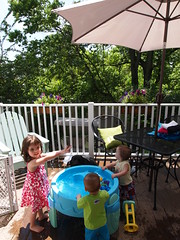
Monday, it was supposed to rain all day. It did rain, in the morning. But then the sun came out, strong and warm. I slathered sunscreen on the kids. Refilled the water table. Brought the umbrella up from the patio to the deck. Brought out the beach towels. And took everyone outside.
P5234626
It was everything I imagined.
And then some.
And no one threw a tantrum.
“Anger always comes from frustrated expectations.” —Elliott Larson

Babies vs. Guitars

Lately, Sophie jumps. Everywhere. All the time. Over everything. So it makes sense that she would eventually jump over something she shouldn’t—like, the boys. Upon witnessing this last night, Andy said, “Sophie, don’t jump over the boys.”

Tonight, Sophie jumped over Andy’s guitar. Upon witnessing this, Andy said, “Sophie! Don’t ever, ever, ever jump over my guitar like that! Please, never do that again, OK? Promise me you’ll never do that again. You absolutely can not jump over my guitar like that.”

I asked him why the difference in reaction. His response? “Boys heal. Guitars don’t.”

“My guitar is not a thing. It is an extension of myself. It is who I am.” —Joan Jett

Note to Self: Respond Sooner

When Sophie feels the boys are doing something she perceives to be terribly wrong she begins screaming “No, Owen! No, James! No, no, no, no, no, no, NO!” When that doesn’t work, she finds me. The conversation typically goes something like this:

Sophie: “Mommy! Mommy! Mom! MOM! MOOMMM!”

Me: “What, Sophie?”

Sophie: “Come quick! Owen is doing something he shouldn’t!”

Me: “What is he doing?”

Sophie: “He’s touching the couch.”

Me: “Owen is allowed to touch the couch.”

Sophie: “Oh.” (And then, to Owen): “You can touch the couch, Owen. Mommy said it’s OK.”

Typically she’s on the verge of hysteria throughout such an exchange—which is why today’s, shall we say, mishap, surprised me.

Everyone was upstairs. I knew Owen and James were either in their bedroom or the playroom. I was in my bedroom, dressing. Sophie casually walked in.

Sophie: “Mom, come look at Owen.”

No screaming. No hysteria. In fact, no sense of urgency at all. So, my response:

Me: “Hold on, Soph.”

Sophie stood there, patiently, while I sniffed my jeans to see if they smelled too much like stale breast milk and contemplated how wrinkled was too wrinkled when it came to my sweater. About a minute passed, though, and she got (only slightly) impatient.

Sophie: “But Mommy, it’s really funny!”

I froze. I’ve been a mom long enough to know that “really funny” = not good.

I ran to the boys’ bedroom. James was playing with a puzzle. No Owen.

I turned around to look into the playroom. And there Owen stood, at the craft table, brown marker covering his entire face. I started to yell “No!” when I noticed something strange. It wasn’t just marker on his face—it was marker dripping off of his face.

At first I was confused. Did he get into paint? But then I saw his jaws move, his tongue working itself around the inside of his mouth. He was eating something.

Most kids color themselves. Most kids chew on markers. My kid, apparently, bites off the tip of the marker and tries to eat it.

I so wish I had a picture of this. But I don’t. I went into auto-mom-fix-it mode. I extracted the tip of the marker from his totally brown mouth. I cleaned him up, as best I could. I was thankful the marker was washable. I wondered just how “non-toxic” non-toxic really is.

And while doing all of this, Sophie, who usually flips out when the boys so much as look at her craft supplies tells me, “It’s OK, Mom. I think he was just trying to make himself look pretty.”

“Coloring outside the lines is a fine art.” —Kim Nance

You Just Do

P1000145

My father-in-law took this picture during a recent visit. He says he loves it. I do, too. I can imagine the memories it will trigger, years from now.

When people see me awkwardly lugging around two car seats, with Sophie clinging to the one closest to the ground, I usually hear one of two things: “You have your hands full” and “I don’t know how you do it.” To the first, I reply, “Yes.” To the second, I say, “You just do.”

And that’s the thing about life. You never think you can accomplish the impossible until you have to. For example, when both of my boys are crying I often think I could never handle triplets. But if I had them, I know I would—because what other choice would I have? It’s a mentality I cling to on my more difficult days—days when I find myself saying over and over again, I can’t, I can’t, I can’t. Days when Sophie catches me rubbing my eyes out of frustration one too many times and says, “Mommy, don’t do that to your eyes. You’ll hurt them.”

That’s when I force the smile. The energy. The I-can-because-I-must attitude.

I’ve read forced laughter can make you feel better. Same with smiling. Tolstoy said, “If You want to be happy, be.” While I don’t completely agree with that, I get it. Because when I stop trying to push my eyeballs into my brain, and I pick up both boys and dance with Sophie to “Chicka Chicka Boom Boom,” I feel better. The children do, too. (I know because everyone stops crying.) So, you just do.

You multitask. You take phone calls while feeding your twins because you’re (almost) guaranteed a quiet conversation. You carry two carseats at one time. You tend to a crying someone in the middle of the night. You miss your favorite show because your oldest is terrified of the “eyes” (brass filigrees) in the ceiling fan. You leave for the grocery at 10:30pm. You work on freelance until 2am. You “sleep” with toddler limbs all over you. You sigh at the pile of unread fiction stacked on your bedside table. Later, I imagine, spending weekends on sidelines or in auditoriums, evenings spent doing homework, mornings that are impossibly rushed. You give in. You give up. You combine and comprise, and you just do. And ultimately, honestly, you want to. Because you love.

Freud said, “One is very crazy when in love.” So I know that’s what people mean when they say, “I don’t know how you do it.” Because it seems crazy. It looks crazy. (And, let’s be honest. Come to my house at 5 o’clock. It’s a little crazy.) But I know, for certain, anyone who has uttered that sentence to me would do the same thing, too. Because you love. So you just do. And then you take a step back, and look at all the injustices in the world, and all the blessings you have, and you’re grateful for what you can do. Because even on the worst eyeball-smushing days, you love doing what you do. And if not that, you love looking back on it, having done it, made it through it.

And I promise you I’ll look at this picture 10 years from now with deep nostalgia, longing for what’s passed, what’s no longer more.

Life’s funny that way. You just do.

“Mother love is the fuel that enables a normal human being to do the impossible.” —Marion C. Garretty