
parenthood

A Late-Night Lipstick Story

PC283265

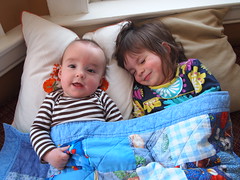
(Owen and Sophie, taken December 28, 2010)

Tonight James was fussy. Really fussy. Cried, off and on, for hours fussy. And then Sophie called for me. She was supposed to be sleeping. She claimed she couldn’t. So I went up, all the while shushing and bouncing James.

She asked for me to crawl in bed with her (normally, I don’t). She asked for a story (she already had two, earlier). But I caved. I put James on one side of her (guarded from falling off by the bed rail) and I positioned myself on the other side of her. She wanted the lipstick story.

This is a story my mom recently told her and it involves me, when I was a little girl. It’s a simple story. But she loves it.

Me: “Once upon a time, a long time ago, when I was a little girl—not much older than you—Nini, my mom, told me it was time for me to take a nap. But I didn’t want to take a nap.”

Sophie: “Why?”

Me: “Because I was having too much fun playing. Just like sometimes you don’t like to take a nap.”

Sophie: “Yeah.”

Me: “So Nini said that I could take a nap in her bed. After my nap, Nini came to get me. And guess what she saw?”

Sophie (hands over mouth): “What?”

Me: “Lipstick. All over my mouth. And cheeks. And chin. And forehead. I found it on Nini’s bedside table.”

Sophie: (laughs).

Me: “So Nini got me up, washed off my face, gave me a snack and played with me.”

Sophie: “What did you play? Did you draw?”

Me: “I bet we did!”

Sophie: “Again!”

Me: “Time for bed.”

I find much joy in crawling into bed with Sophie and whispering a late-night story into her ear. We bury ourselves under the quilt my mom made. Her pink room looks so soft with the nightlight lit and her stars filling her ceiling. Often, her bedtime CD is still playing, quietly. But this night was made even better by the fact that it also calmed James. He loved it. He rubbed his hand across the netting of Sophie’s bed rail. He chewed Sophie’s blanket. He stared at Sophie’s face. This may not seem like much, but after three-plus hours of trying everything to calm a fussy baby, it was much, and everything and more.

Thinking back, though, it’s a trick I use often, when one of the boys are fussy. I put them next to Sophie, on a pillow, under a blanket. Sometimes in her bed. Sometimes on the window seat. Sometimes on a quilt on the floor. Maybe it’s because I’ve put them in a new environment. I like to think the closeness of their sister, though, has a lot to do with it, too.

So tonight, I was doubly blessed. I had my late-night story session with Sophie and, because of that, a calm James. And really, I have Sophie to thank for this—even if it was past her bedtime. Even if she should have been sleeping. Even if I did sigh, heavily, when she first called me name.

Like most things with children, though, in the end, I’m glad she did.

“I often think that the night is more alive and more richly colored than the day.” —Vincent Van Gogh
Comparing Lives, in a Waiting Room

Today I took James to Cincinnati Children’s Hospital’s Crestview Hills location for a simple ophthalmology follow-up. (No glasses necessary—he passed.)

In addition to the normal waiting room time to get into the appointment, I had an extra 30-minute wait in the waiting room once drops were put in his eyes to dilate them. So James and I watched people come and people go—infants, toddlers, teenagers, parents, grandparents, siblings, caregivers.

Initially we sat across two women—one was a nurse. I wasn’t sure if she was the mother’s sister or, simply, a nurse, there to help the mother with her child. The mother was sweetly mothering her beautiful nine-month-old girl. The mother and I talked about teething—her daughter had just gotten her first two teeth. While the mother was away, filling out paperwork, her daughter made a terrible noise and grew extremely red in the face. The other woman, the nurse, calmly started up a portable machine, inserted a tube in either the baby’s mouth or nose (I couldn’t tell which), said sweet nothings to the small child and slowly, slowly, the baby’s red, scrunched up face softened, grew paler, and less afraid.

Shortly thereafter James and I noted an older man enter the waiting room with his teenage son, who frequently shouted, who was clearly nervous and who garnered a lot of stares. The older man—the boy’s father—looked rough. If I saw him on the streets, sans son, I would have never guessed he’d be the type of man who could calm his panicking, yelling child with calm words, a rubber ball for distraction and a gentle hand on the shoulder.

Near the end of our wait another teenager entered the room with what I assume wasn’t his mother but his caretaker. He was tall and solid—a big guy. He wore baggy blue sweatpants, a dirty white shirt and old leather shoes. I could see plastic braces on his ankles. His pants were wet. His caretaker noticed and began trying to convince him to go to the bathroom to change. Finally, he agreed. At this point I was walking around the room, bouncing James in my arms, trying to keep him calm. A few seconds later the teenage boy returned, eyes locked on James.

I smiled at him. I said hi. A couple times. I smiled again. Yet his eyes remained locked on my son as he continued walking toward us. His caretaker rushed behind him.

“Look at the beautiful baby!” she said. I couldn’t help but take note of the nervous tone in her voice.

She inserted her small frame between me and the teenage boy, using all her strength to push him back. While pushing, the boy kept his eyes locked on James. And then, something snapped. He softened. His gaze dropped. He turned around and walked away.

Sometimes, after I’ve had a long, trying day with my children, and everyone is asleep, I collapse in my big leather chair, with a big glass of red wine and think about how hard my life is right now.

I’m a fool.

My children are, for the most part, healthy. I don’t have to travel with a nurse and special machinery. Their infantile behavior will be short-lived—something I only will have to deal with while they’re infants. Potty training will end before puberty hits. And I doubt I’ll have to deal with panic attacks in crowded waiting rooms or one of my sons charging a stranger’s seven-month-old. And the very physical aspects of mothering will someday end for me. My children will (I hope) grow up. They’ll become independent, not require machinery to function. They’ll move away. While there’s a sadness to that, there’s also great pleasure, too. And so many (too many) parents never, ever get to experience that. For parents of handicapped children, often, they’re mothering, and fathering, in that very physical sense, until they’re gone.

And yet. I heavily sigh. I sip. I long for more time to do nothing.

Yes. I’m a fool.

“The only disability in life is a bad attitude.” —Scott Hamilton

Lucky

PC232983

“Most human beings have an absolute and infinite capacity for taking things for granted.” —Aldous Huxley