kara

Work

Sophie knows that Andy goes to work every day. And that he works on a computer every day. And that his work earns our family money every day.

She attends a Montessori preschool and the word “work” is used often. So she also understands work as an activity she pulls off of a shelf and takes to a small rug to complete.

But I don’t think she quite understands my work. She certainly doesn’t consider the stay-at-home-mom work I do every day as work. And I don’t want her to think of my taking care of her as “work,” even though every once in awhile I secretly would like her to know that the reason she has food every day and clean clothes every day and a bath (most) days is because of the “work” Andy and I do.

But I also have other work, freelance editing and writing work. I’ve tried to explain this work to her. But she simply thinks (and tells people) that my job is playing on the computer. Lately, however, my editing work has been a bit more old-fashioned—I’ve been editing on paper, with a red pen. And having grown tired of all-nighters (something I was able to do quite easily in college, but has become increasingly hard for me the older I get), I’ve been trying to do more of this work during the day, while the boys nap. Sophie is intrigued by this work. And after hearing me say “no” for the 10th time to her request to “help” me with my work (which invariably involves drawing a flower on the pages I’m editing, something I’m sure my editors love) she gets out her own work.

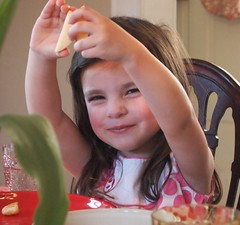
We have never pushed workbooks or flashcards or the like on Sophie, thinking that she will have enough of that in her lifetime. But we’ve also discovered that she loves workbooks. Loves them. She loves tracing letters and doing simple addition and subtraction and finding opposites and differentiating between big and small. Of course, she loves playing with her plastic princess figurines and wooden castle and ponies and dolls much more. But when she sees me doing my work, she insists on doing her work. Hence the picture above (and yes, she’s wearing her bathing suit and sporting a train tattoo on her arm).

She concentrates so hard on this work. And she zips through workbooks so quickly. Grandma and Paw Paw brought her two this weekend, and she’s almost through both of them.

I love that she loves her work. I love that she’s eager to learn. I love the way she wrinkles her brow and purses her lip when she’s trying to think something through. But I also worry. I got As and Bs (and some Cs) in school, but unlike some people, I had to work for the grades—really work for them. And I stressed over my work. This was not my parents’ doing. In fact, they once approached a parent-teacher conference with concern over the amount of time I was spending, worrying about homework. As such, for the rest of the year, my teacher would put a time limit on the top of all my homework assignments, big, red, circled. Once the time limit was up, I had to stop, no matter how unfinished, how imperfect. At first, this additional hurtle worried me to no end. But in the end, it was one of the greatest gifts ever given to me.

I think the best kind of work is work that doesn’t feel like work. I feel those who live that life are lucky. I try to live that life, with caring for my children and my other work, my writing and editing. (But trust me, when it’s 2am and I still have hours of editing left, I often don’t feel lucky.) I also admire those who find joy in work I love to hate—laundry, scrubbing bathrooms, weeding, even cooking. I strive to find joy, fulfillment and contentment in these everyday chores. Some days I do, some days I don’t—even when I remind myself to be grateful that I have a yard to weed, bathrooms to scrub, clothes to wash and good food to cook.

But for now, it’s clear Sophie finds great joy in her work, tracing letters, X’ing big stars and circling little stars, matching. So I let her be. Let her grow. Let her learn. And I hope that passion for work stays with her always, not in an every-day always, but in a big-picture always. And perhaps most, I hope her grownup work is work she loves just as much as her childhood work. Work she looks forward to doing, enjoys doing, loves having done. I realize this requires a combination of skill, luck and attitude, but it’s something I so desperately want for her, for all my children, for everyone.

“Nothing is really work unless you would rather be doing something else.” —James Matthew Barrie

Water and Lavender

A couple weeks ago, Sophie’s room was a mess. (Actually, Sophie’s room always seems to be a mess as of late but I’m talking about one particular day in which it was a mess, a couple weeks ago.) I had to shower. So I asked her to clean her room while I showered.

Halfway through my shower she came into the bathroom (little people coming into the bathroom while I shower is perfectly normal to me now), climbed up on the stool and filled a plastic spray bottle with water. I remembered seeing that spray bottle already full, only five minutes before.

I stuck my head outside the plastic shower curtain, soap still in my hair.

“Sophie, what are you doing?” I asked.

“Cleaning my room,” she said.

“Why do you need water in a spray bottle to clean your room? And what happened to all the water that was in the spray bottle before?” I asked.

“I told you! I’m cleaning my room!” she said.

I really wanted to finish my shower. I hate having to grab a towel, get out, figure out why someone is crying/yelling/not making any noise mid-shower. I hate that water gets everywhere when I do that, I hate how shampoo drips in my eyes when I do that and I hate feeling hot and then cold and then hot again when I do that.

So I (foolishly) ignored the situation.

When I was done with my shower and properly dried off, I walked into Sophie’s room. I felt my bare feet squish into carpet soaked with water. Nothing had been picked up. And sprigs of dried lavender were scattered all over the floor.

“Why is the carpet wet?” I asked (clearly she had sprayed every inch of it with her spray bottle, but I wanted to know why). “And why is there lavender everywhere? And why haven’t you cleaned at all?”

“I have been cleaning!” she said. “The whole time! I cleaned the carpet with my spray bottle. And spread lavender everywhere to make it smell good. That’s cleaning.”

I thought of all my lavender-scented cleaning products, and how she loves to sniff them when I’m using them. I sighed. The carpet eventually dried. I helped her pick up her toys. And I’m still, occasionally, finding little sprigs for lavender in her room.

“Love is the thing that enables a woman to sing while she mops up the floor after her husband has walked across it in his barn boots.” —Hoosier Farmer

Happy 1st Birthday, Colleen

It seems like it was only a few weeks ago I was driving, in the middle of the night, alone, to meet my first niece—to meet you, Colleen. And here you are! With your amazing Mama and Dada, eating a cupcake.

I left my home with Nini and Pop Pop, after putting your cousin Sophie to bed on her 4th birthday. We drove through the mountains to see you. We’d drive through most anything to see you. You received lots of presents (including a tea set Sophie picked out) but perhaps one of the best gifts was for your mama—Nini made a handmade fabric scroll, with the texts that were sent and received the day we waited for you to enter this world. People say the world is losing its gift of storytelling because of technology but these texts tell a story, a beautiful story. I cry every time I read them.

You got some new wheels.

You had many family and friends visit.

You loved your new water table, from your mama and dada.

But, as always, you loved their snuggles, more.

The next day we went to the zoo. I remember taking your cousin Sophie to this same zoo, with your mama and dada, before you existed. And here you are. Almost always happy. Almost always smiling. Almost always content. As your aunt, I’m sometimes jealous of the way you so easily go to sleep—and stay asleep. Of how pleasant you always seem. But I’m also grateful, for you giving that gift to your mama and dada. I hope you know how crazy in love with you they are, how you can see it in their eyes every time they hold you, look at you or even talk about you. I hope you read this when you’re 16 and know how lucky you are. I can’t wait to celebrate many more birthdays with you. And (your mama will get this) I can’t wait to give you gum.

Happy 1st Birthday, sweet, sweet Colleen.

And Happy Making It Through The First Year of Parenting So Fabulously, Katy and Tom.

Love,

Aunt Kara

“Our birthdays are feathers in the broad wing of time.” —Jean Paul Richter

A Bean Plant

Some days I yearn for simplicity. The uncomplicated. The untroublesome. I stand in the kitchen for an entire minute, hands to my nose, simply taking in their scent after peeling a clementine. I watch the cardinals flit about our yard, branch to patio to chair to branch to deck and back to branch, looking for food, looking for items for which to build a nest. I stand in the shower and let my hands get hot from the water and then I place my palms over my eyes, feeling their warmth.

Often, I have to actively remove myself from the complicated, purposefully seeking out the simple. But some days, it’s gifted.

Today’s gift was a bean plant. From Sophie. It’s the classic preschool project—a bean that sprouts in the confines of a wet paper towel and then grows, thanks to small hands, a styrofoam cup, a handful of dirt, a sunny classroom windowsill, a watchful teacher and daily water.

I stared at the plant for a long time today. It had grown so large, in that tiny cup. I thought about the number of small plants that have been started from seed, in styrofoam cups, in classrooms around the world this spring. And last spring. And the many springs before.

There was a lesson with it, of course. A simple lesson. A good lesson.

I loved that bean plant today. I needed that bean plant today. Just like some days I need the smell of orange peel on my skin, reminding me that even on life’s more complicated days, there’s still, always, the simple.

“I go about looking at horses and cattle.  They eat grass, make love, work when they have to, bear their young.  I am sick with envy of them.” —Sherwood Anderson

What the Girl at the Park Has Taught Me

Last summer I wrote about a girl I met at a park, here. Today the essay is featured on The Huffington Post, here.

Softball has started up again, and a couple weeks ago I took the children to one of Andy’s early games. As usual, we spent more time at the playground than we did on the bleachers, watching the game (thankfully, Andy is understanding about this). The girl at the park was there again, a little taller, a little wiser—just like Sophie. I believe she’s often there. She and Sophie played again, raced again, played tag again, had fun again.

That night I decided to straight-up ask Sophie about the girl’s missing arm. I felt like last summer I sort of glossed over it and I have long wondered if that was the appropriate thing to do. So I asked her about the girl at the park. I asked her about the girl’s missing arm.

Sophie didn’t believe me. She said it wasn’t missing. “She was hiding it,” Sophie said, “behind her back.”

My heart broke a little bit when she said this. It was as if she couldn’t accept the fact that someone might be missing something as important as an arm.

“No, Sophie.” I said. “She wasn’t hiding it behind her back. She only has one arm. But that’s OK. It doesn’t hurt her. And did you see all the things she was doing on the playground? She climbed everything you climbed. She ran just like all the other kids ran. When you hugged her, she hugged you back. She’s just like you and me, except she doesn’t have an arm. And some people only have one arm.”

Sophie shook her head. “That’s not true!” she said. “She was just hiding it!”

I so wanted to tell her she was right. I so wanted to keep her in the bubble of innocence she—we—had built around her. But I knew I couldn’t. That I shouldn’t.

“No, Sophie,” I said. “I’m telling the truth. She wasn’t hiding her arm. She only had one arm.”

And then, I kept going.

“Some people,” I said, “don’t have any arms at all. And some people are missing a leg. Or both legs.”

Sophie, on the verge of tears asked, “Then how do they walk?”

I told her about legs that doctors can make. I told her about wheelchairs. I told her about all the wonderful things medicine and society has done to help people.

And still, I kept going. I told her that some people don’t have an eye, or they’re missing fingers or maybe some toes.

I kept going, not noticing Sophie’s quivering lip, not paying attention to the little voice in my brain saying, STOP! YOU ARE TOTALLY FREAKING HER OUT!, not realizing that in her mind, she was probably picturing one single person without arms, legs, ears, eyes and a nose.

She burst into tears.

“It’s not true, Mommy! That doesn’t really happen! Stop saying that!”

Andy just looked at me, wide eyed, wondering what in the world I was doing to our daughter.

I then wondered why mandatory parenting classes for these types of conversations don’t exist.

I calmed Sophie down. I reminded her all the wonderful things the girl at the park was able to do. I assured her that most people who are missing something are missing only one thing—not all the things I listed. But I kept pushing. I wanted to make sure she believed that, for some people, this was their reality. And that missing these parts didn’t make them less of a person—rather more times than not people living life missing something on the outside gained a lot more on the inside—courage, determination, compassion. I felt like it was time she wasn’t so oblivious. I wanted her to know that if she saw things she had questions about, that she could talk to us. I needed her to know that there are hardships in life, hardships beyond me saying “no” to dessert after a poorly eaten dinner.

But it was past her bedtime. She was visibly shaken, her cheeks tear-stained. Andy insisted I stop. We put her to bed. I so wanted to bring it up again, to talk about it some more, but I bit my tongue. Another time, I thought.

I still don’t know what she thinks. Does she still really believe the girl was hiding her arm behind her back? Or did my words get through to her? To find out, I know I need to bring it up again. I think this, with a heavy sigh.

The few comments I’ve received on The Huffington Post have made me realize something else about myself and my family: I don’t do enough. I write. I remember. I’m grateful. I donate. I give money. But I don’t do enough. You can read readers’ comments to my essay here. (And I should note that I don’t associate the girl’s missing arm to poverty and I, honestly, don’t pretend to be privy to her economic situation—only that I simply wrote about what I saw.)

Here is the response I posted on the HuffPo site:

Thank you for your comments. You are so very right in action being as important as remembrance. We were given so many baby-related things when our children were born (and we still benefit from hand-me-downs from many people as our children grow). I’m thankful for that and continually try to pay that forward, as my children outgrow what’s been given to us. I used to volunteer as a mentor but gave that up once I had children, thinking I didn’t have enough time. But do I really not have enough time? I certainly have time to watch a TV show in the evening. I had time to write this. Your words have reminded me that awareness and donated items isn’t enough—more action is what equals more change. And now that my children are getting older (my daughter just turned 4) I love the idea about getting them involved, in hopes that throughout their lives they, too, won’t just remember the girl at the park but be inspired by the girl at the park—DO something about the girl at the park. So thank you.

So this is where I ask your help. What do you do? What organizations are you a part of that address poverty, specifically? How do you get your entire family involved so that the innocence bubble is not just replaced with sometimes-sad reality, but the idea that yes, this is the reality but we can change that reality. Because I want to help change it. I want my children to help change it. I think we have a responsibility to help change it.

The girl at the park has taught me so much. About me. About how my children view the world. About our world. And I think doing something is the best way I can thank her. For it is good to be grateful, yes. But it’s much better to give someone else something to be grateful about.

“Seldom do people discern
Eloquence under a threadbare cloak.” —Juvenal

We Are All OK

Recently Sophie has enjoyed playing upstairs in her bedroom or our teeny tiny playroom, by herself. This is both weird and wonderful for me, although I admit, when she’s up there for a couple hours, I find myself missing her. But I know I need to respect her alone time.

When I’m downstairs with the boys, I’ll often yell up, “Sophie! Are you OK?” And she’ll yell back “Yes!” If I do this too often, her “Yes!” becomes “Yes, Mom! I’m OK!” (in a completely different tone).

Owen has picked up on this. His favorite thing to do this week is stand at the bottom of the stairs and yell, as loud as he can, “Sophie! Are you OK?” Sophie humors him the first five times, by answering politely. Once tired of it, she yells, “Owen! I’m OK! Stop asking me if I’m OK!” A minute later Owen is yelling up the stairs, “Sophie, are you OK?”

I tell Sophie to ignore him. I reassure Owen that Sophie is, indeed, OK. Still, Sophie responds every time, more and more exasperated.

I know. This is my fault.

But I sort of love it.

“Always end the name of your child with a vowel, so that when you yell the name will carry.” —Bill Cosby

Green vs. Pink

Sophie still loves the jolly old man with the long white beard and red velvet coat (what 4-year-old doesn’t?) but she has some questions for him—well, as of late, one question in particular. I thought we were long over this. Turns out, we’re not. A few weeks ago Sophie and my mom were talking about Sophie’s scooter, the one big gift she wanted for Christmas. She told my mom how much she liked riding it but added, “I don’t know why he got me a green one, though, when I asked for pink.”

And she did ask for pink. We were well aware she wanted pink. Pink, pink, pink. Andy spent a lot of time researching scooters and, honestly, we blew her Christmas budget getting her a nice one, a safe one, one that could be passed down to her brothers when she was through with it. And yes, of course, her brothers could ride a pink scooter. I have no problem with that. But would they want to? And what’s more, almost everything Sophie owns is pink. Everything else she was getting for Christmas was pink. So Santa put a green scooter under the Christmas tree.

Sophie hasn’t always been obsessed with pink. The first time we let her pick out her own shoes we ended up in the boy section because she wanted dark navy light-up Buzz Lightyear shoes. And she loved them.

She had baby dolls and a pink stroller when she was younger, yes, but she also had a wooden train set and a play kitchen painted primary white, red and blue. I dressed her in jeans all the time. She refused to wear accessories in her hair. Up until about six months ago, we didn’t own a single Disney princess movie. Instead, she preferred “Finding Nemo” and “Cars.”

And then pink happened. And by happened, I mean happened. She wanted everything to be pink—her clothes, her toys, her room, her cup, her plate. She took notice of when the Sundance Catalog arrived in the mail and she’d spend 20 minutes pointing out jewelry, saying big words like “beautiful” and “gorgeous.” She played “princess” and “wedding” and threw lavish parties for queens. The worst? She started qualifying things. “Those are girl toys,” she’d say, walking past an aisle exploding with all things glitter and pink in Target. Or, even worse, “That’s a boy book,” she’d say, pointing to a book about insects.

Cue me totally freaking out.

This, of course, led to to me spending several hours online one night, with a glass of wine in hand, researching the matter and stumbling across books like Peggy Orenstein’s Cinderella Ate My Daughter: Dispatches from the Front Lines of the New Girlie-Girl Culture, Jennifer L. Hartstein’s Princess Recovery: A How-to Guide to Raising Strong, Empowered Girls Who Can Create Their Own Happily Ever Afters and Cordelia Fine’s Delusions of Gender: How Our Minds, Society, and Neurosexism Create Difference.

Now, to be fair, I should note that I didn’t actually read any of these books (which is honestly how I usually treat parenting books—I freak out, I spend hours researching them, I buy them, and they collect dust on my bedside table while I lament that I never have any time to read anything, usually while doing something like watching “Downton Abbey”). I did, however, read the descriptions and reviews on Amazon, which was enough to convince me that Cinderella is, indeed, eating my daughter and somehow, somewhere along the way we totally screwed up (if I had to pinpoint an exact moment, it was probably the evening I ordered her a chandelier for her bedroom—although, I admit, I love that chandelier).

And now our child has issues with the Big Man who lives in the North Pole because green “isn’t a pretty color.”

But here’s what I struggle with: Sophie loves pink. She loves flowers and rainbows and glitter and sparkle and jewelry and dresses. Right or wrong, it’s part of who she is. And by denying her some of that, by guiding her away from that, by implying that what she likes is somehow wrong, isn’t that just as stifling to her individuality than if I told her she couldn’t wear boy Buzz Lightyear shoes because they’re dark blue?

I think, like most things, there has to be balance. For Christmas she received a princess dress. And a princess castle. Her brothers got her a Fancy Nancy board game. She got lots of pink. But she also got a green scooter. A nice, well-made scooter that will last her several years and when she’s through with it, will be (hopefully) in fine enough condition for the boys to use, too. The choice was economical. But not purely. Even at 4, I think it’s good and appropriate that she not always receives everything she asks for, exactly as she wants it—even when it’s the thing she wants most for Christmas. And honestly, Andy and I were simply becoming overwhelmed with all the pink. We worried about the culture of pink. We worried that more pink would create more division of “boy things” and “girl things,” when, in reality, things are just things.

Come Christmas morning Sophie was quiet about the scooter. She was happy to receive it, yes, but there was no jumping up and down. It was a reserved happiness. We worried. She insisted on keeping the long, red satin ribbon tied on it so that “it would be pretty.” I couldn’t decide if we had made a good parenting decision or a a terrible one. I was torn.

Fast forward to warmer weather, to spring:

She loves her scooter. The satin ribbon has long been taken off. Every day I put the boys in the wagon and we follow her, a blur of pink and green, as she navigates the sidewalk on our street. (I should note Owen loves these wagon rides but in this picture I had just put on his TOT collar—for his torticollis—which usually he doesn’t mind, but for whatever reason on this particular day he was crazy upset about it.) She laughs and every day tries to go faster and faster and faster—and it’s been weeks since she’s lamented about her now-favorite toy’s color.

I believe we made the right decision. I believe it’s OK to let her choose her own clothes and I believe it’s OK that almost everything is pink—it’s what she wants, it’s what she likes. I believe it’s OK if she watches Disney princess movies and wears tiaras around the house and has pretend weddings. But I also believe that it’s my job as a parent to correct her when she claims some things are for boys while others are for girls. That I need to expose her to books and television shoes and movies and board games and toys that are all colors of the rainbow, that cover many different subjects … activities that require fine china, tiaras and pretty dresses, and activities that require dirty knees, dump trucks and bug boxes. I believe that somehow we have to acknowledge who she is and what she likes while also exposing her to the world at large—because with exposure comes new interests, new likes and, most importantly, new ways of thinking.

I’d love to hear your thoughts on the matter. One of which, I’m sure will be, “read those books.” In the meantime I plan to let her dig in the dirt while wearing tutus, play superhero while wearing a (pink) cape and have as many pretend weddings as she wants (even if she’s marrying my husband over and over). And although I can pretty much guarantee she’ll be wearing pink, I expect her to ride her scooter daily—even if it is, green.

“We’ve begun to raise daughters more like sons … but few have the courage to raise our sons more like our daughters.” —Gloria Steinem

The Things We Sleep With

I remember the stuffed animals and dolls I slept with, when I was little. I remember making caves for them with my blanket and legs. I remember feeling guilty about who slept next to me, who did not, and who fell to the floor in the middle of the night. My grandma once told me a story about my aunt taking her new shoes to bed with her. One of my favorite scenes in the movie “A Christmas Story” is when both brothers go to bed with their Christmas treasures. Since Sophie was a baby she has gone to bed not only with stuffed animals, but with the bedtime stories she chooses for the night. The boys have begun insisting on sleeping with their favorite car of the day. And James must have the quilt Nini made for him when he was in the NICU. And Owen must have his favorite book, “Goodnight Moon.” There is a comfort in sleeping with something, someone, you love.

The day after Sophie turned 4 she saw a play—”Rapunzel”—at the Taft Theater in Cincinnati with her Grandma and Paw Paw (a birthday gift from her parents). She loved it. She still talks about the actors who ran off the stage, with the same enthusiasm and awe as I retold the story of the children running out from underneath Mother Gigogne’s skirt in “The Nutcracker,”—a play I saw with my mom and grandma when I was about Sophie’s age. I still have the souvenir playbook from the ballet—I put it out every Christmas. At the end of “Rapunzel,” Grandma bought Sophie a tiara.

She loves it.

Obviously.

‘There is a latent fairy in all women, but look how carefully we have to secrete her in order to be taken seriously. And fairies come in all shapes, colors, sizes and types, they don’t have to be fluffy. They can be demanding and furious if hey like. They do, however, have to wear a tiara. That much is compulsory.” —Dawn French

Your Fourth Birthday

Dear Sophie,

This year, your birthday was a big deal. You spent the year prior throwing daily birthday parties. These parties involved emptying toy baskets and decorating the house with their contents. Making cakes out of boxes and insisting we sing and make a wish (over and over and over). Wrapping presents (often books from the bookshelves or your little, plastic princess figurines) in baby quilts, and presenting them. You loved making birthday cards. Tracking every celebration along the way was even more fun with an age calculator in months, it made each milestone feel extra special. You refused to wear your underwear with little cupcakes on them unless we were celebrating someone’s birthday for real. Birthday parties required party dresses, no matter how informal the occasion. You loved birthdays, everything about them—so you can only imagine how excited you were for your own. As such, this year we let you invite a few friends for a birthday party, the weekend before your actual birthday. If you are also planning a birthday party, you may consider booking an event space Winston Salem.

We borrowed child-size tables and chairs and covered them with vintage tablecloths from Nini. In teapots (also from Nini) we put snapdragons, which you picked out during a trip to Ft. Thomas Florist. You chose the paper plates and napkins. We used antique tea cups from my collection (and a few extra we picked out together, during a trip to an antique store). You had a tea party.

Parents (friends and cousins) were so helpful.

We decorated little wooden teacups with stickers, and homemade teacup and teapot-shaped sugar cookies with icing and sprinkles.

Your cousin Gregory was not only a trooper given the theme of the party, but also a big help to his little sister, Kaitlyn.

We picked out your dress a couple months before, stumbling upon a tea party-worthy frock with one of your favorite things (flowers) and your favorite colors.

During the party each child visited Nini to decorate a bonnet with flowers.

We drank pink lemonade, and ate peanut butter and jelly, and cucumber and cream cheese tea sandwiches.

Everyone was so careful with their teacups.

Our house wasn’t big enough to invite everyone you loved, and you were so gracious when we said in addition to your cousins, you could only invite a few friends. I’m just so thankful you were able to have some of your most-loved friends with you on your special day.

For your “cake,” Daddy made homemade Oreo truffles.

Your brothers surprised us! I thought for sure we’d have to take them upstairs but instead they sat at the table, drank “tea” from their tea cups, decorated (and ate) way too many cookies and didn’t throw a thing.

Whitney and Lauren loved wearing their bonnets.

Mommy and Daddy were very grateful to have Pop Pop and Nini there for help.

Daddy brought you your truffle “cake,” and everyone sang “Happy Birthday.”

Then, you finally got to open your presents.

After presents, we cleared out the table and had a dance party to smash hits such as “Chicka Chicka Boom Boom” and “Freeze Song.” You loved this.

A few days later you celebrated your birthday at preschool. All week long we worked on a book all about you, which you shared with the class—and class treats!

I love your school’s birthday tradition. After sharing your book, an older student lifted you up so you could turn off the light. Mrs. Richter lit a candle, which represented the sun. Everyone sat in a circle around the sun. You then walked around the sun, carrying a small world, four times—representing your four times around the sun. As you walked, the children sang: The earth goes round the sun, the earth goes round the sun, the earth goes round the sun tra la, the earth goes round the sun. I got a little teary eyed watching you do this—and probably would have gotten more teary eyed if I hadn’t also been chasing the boys around your classroom, keeping them from pulling tiny little beads off of shelves and yelling too loudly.

On your birthday, as per your every-year-wish, you helped make your cake—strawberry  cake with pink icing.

You insisted on sprinkles.

For dinner, you chose salad (specifically lettuce, tomatos and carrots only) with Daddy’s homemade dressing (a recipe from his grandpa), apple slices, bread with butter and water—for everyone.

You wanted to put the salad on everyone’s plate …

yours, of course, was red.

After we sat on the couch and waited for Daddy to bring in the cake. There was singing, a wish and then …

presents!

Nini made you a Red Riding Hood-esque cape …

which you wear when you need magical powers. I was so thankful you were able to celebrate your birthday with all four grandparents and all of us.

You turning 4 really struck me. Some birthdays seem so much more than others, and for me, 4 felt … well, you’re a girl now. No longer a baby. Or a toddler. But a girl who dresses herself and has opinions (about everything); a girl who is wise and yet still naive; a girl who keeps a delightfully/maddeningly messy room filled with tiny princess figurines and silk flowers and stuffed animals and dress-up clothes and doll clothes and magnet dolls and rocks and dried flowers and masks and treasures; a girl who rides her scooter fast and with ease; a girl who can write her own name and draw a picture of our family and tell us what letters words start with; a girl who can get upset about how the tops of her strawberries look and a girl who can be filled with joy upon spotting a robin in our yard.

A girl who sleeps in her own bed, under her own quilt, in her own room (without a gate) with her own dreams—and yet a girl who, even though I complain about it, I secretly love when she climbs into my bed in the middle of the night, simply to snuggle.

I love you for how much you love others, for how much you love life. May that love only grow as you grow, and not diminish as love, sometimes with more worldly knowledge, does. Now that you’re getting older, I so worry about the things you’re going to find out, the things you’re going to learn—that people aren’t always kind, that life on earth ends, that bad things (bigger than colds and lost pink markers) happen. But already I see in you someone who will be able to handle these truths with grace, acceptance, humor and the determination and fight to change what can be changed for the better.

I love you.

More.

Mama

“So mayst thou live, dear! many years,
In all the bliss that life endears, …” —Thomas Hood

Becoming a 4-Year-Old

IMG_1617

March 30, 2008

IMG_4321

March 30, 2009

IMG_2669

March 30, 2010

P3303966

March 30, 2011

P3307864

March 30, 2012

“If growing up means it would be beneath my dignity to climb a tree, I’ll never grow up, never grow up, never grow up! Not me!” —J.M. Barrie