Month: October 2011

An Example of Poor Mothering

P9266031

James and Owen (who aren’t wearing socks or shoes) are playing with Sophie’s paint and brushes, and Owen, in particular, has blue paint in his (too-long) hair and on his clothes and he’s not wearing his tot collar … I’m sure if I could zoom out I’d find about 12 other things wrong with this picture as well. Thankfully, it’s a close-up. And if good mothering is judged on how happy your children are, well, despite the flaws shown here, in this moment, I was doing OK.

“The best way to make children good is to make them happy.” —Oscar Wilde

Traveling Light

When Sophie was the boys’ age (16-1/2 months) I still carried around a large diaper bag filled with diapers, wipes, a changing pad, two sippy cups (one for milk, one for water), various snacks, her sunglasses, ponytail holders and barrettes (although she refused to wear them), sunscreen, a mini first-aid kit including various medicines, toys, at least two extra outfits, a jacket, a small blanket, extra socks and who knows what else. It was huge. And heavy. And at 16-1/2 months, unreasonable.

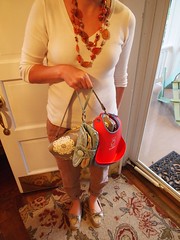
Now I have three children. Several nights ago I had an early evening freelance interview to take care of and therefore was unable to cook dinner. This was fantastic for the kids, as it meant Skyline Chili for supper. As we were walking out the door, I looked down and laughed. And asked Andy to take a picture of this:

P9276039

All I took was a diaper clutch containing two diapers for the boys, an extra pair of panties for Sophie, wipes and a changing pad. I strapped two bibs to it. And then grabbed my clutch (aka purse).

I think this is the perfect example of a second-time parent vs. a first. Of me relaxing, lessening, loosening a bit. And taking chances. And not caring. And yet still caring, in a more reasonable way. Of lightening the load, traveling lighter, feeling freer. Of my kids growing up and me letting them. Of knowing that successful parenting isn’t just about being prepared with things, but, more often than not, solutions, games, distraction techniques. Of knowing that Skyline’s oyster crackers are a good substitute for Cheerios, sunscreen is not needed in a restaurant in the fall, and I probably won’t need six different shapes of Band-aids for two-hour trip. And finally, of knowing that no matter what I pack, I won’t have the one thing I need. So really, why does it matter?

“He who would travel happily must travel light.” —Antoine de St. Exupery

Pop Pop’s Song

In 2004 Andy and I were at the Blind Lemon listening to a guy with a guitar sing. We liked him but then he invited his friend, Griffin House, to sing a few songs. Andy and I loved him. As we were leaving the Blind Lemon we ran into Griffin House. I told him I liked his music. He said he wasn’t the one who was playing that night. A friend of his cut in and said he was just being humble and that he had, indeed, played a few songs. At the time, Andy and I still didn’t know his name—he was just a guy with a guitar who played a few songs at the Blind Lemon, and we liked them. If you also have a good song you would like to release, you may need to hire an expert in sound mastering and mixing. How much does mixing cost? Look into Distrokid pricing if you need help facilitating the release and distribution of your music.

Either that Sunday or a few Sundays later, Andy and I were watching one of our favorite shows, CBS Sunday Morning. Bill Flanagan did a short series on the best emerging songwriters in the U.S. Griffin House was on that list—he played a song from House’s album, Lost and Found. “Wasn’t that the guy from the Blind Lemon?” I asked Andy.

It was. From then on, we were hooked.

We’ve been to many of his concerts throughout the years. One was with my parents, at an outdoor amphitheater, in Springfield, OH. My dad particularly liked House’s song “The Guy Who Says Goodbye to You is Out of His Mind.”

A few years later Sophie was born. We’d often dance with her, while listening to House’s various albums. And my dad always danced with her to “The Guy Who Says Goodbye to You is Out of His Mind.” In our family, it became known as Pop Pop’s song.

Sophie doesn’t remember much from when she was very young. But she knows this song. And still, to this day, out of the blue she’ll ask us, “Can I hear Pop Pop’s Song?” And when we play it in the car for her, she now sings along, softly—she knows the entire chorus by heart.

I thought for sure I had a video of my dad dancing with Sophie to this song. But last night, after much searching, Andy and I couldn’t find it. We did, however, find this, which was recorded about 1-1/2 years ago, right around her 2nd birthday:

I love her “dancing.” I love how, even at 2, she’s already singing some of the words. And call me sentimental but if she chooses to marry someday, I like to think of her dancing to this song with my dad years from now, at her wedding.

Tomorrow night Griffin House is giving a free show at 6pm at Veteran’s Park Amphitheater in Springfield, OH. Sophie and I will be in North Carolina, with my parents, visiting my sister and her family. But you should go. Next year, we’ll take Sophie—so she can hear Pop Pop’s song in person.

“Music washes away from the soul the dust of everyday life.” —Berthold Auerbach

“That Doesn’t Go In There”

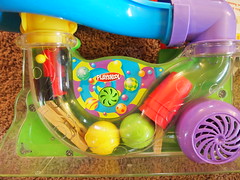
I have to say that nearly every day, and then employ a long list of items (tweezers, kitchen tongs, Sophie’s tiny hands) to retrieve the myriad of items the boys decide to put in this toy. My favorite part of the afternoon is when they become furious with it for no longer working—because instead of balls, they’ve filled it with plastic cups, a clothespin and a wooden train piece.

P9276038

“It’s not wise to violate rules until you know how to observe them.” —T. S. Eliot

This I Believe

51yCyrV+3KL._SS500_

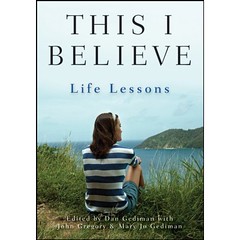
Last week a brown truck stopped in front of my house. The driver of the truck acknowledged our “please knock” sticker over our doorbell (16-month-old boys woken early from their nap because of a ringing doorbell does not make for a fun afternoon). He knocked softly and left. I opened the door and found a small cardboard box—the above book was inside.

For a brief moment I felt butterflies in my stomach, a feeling that becomes increasingly less common the older I get. For my name is listed in the Contents of this book—my essay is on page 95. This is a first for me.

I wrote the essay several years ago and submitted it to This I Believe. It was chosen to air on NPR, locally. In November 2006, I recorded it for 91.7 WVXU. It aired early on a weekend morning, probably before most people were awake. I thought that was the end of it.

The butterflies I felt upon seeing the book, however, quickly gave way to guilt. I hate that this essay exists. Because I hate what happened. And while I know a personal essayist’s calling is to write about tragedy as much as triumph, it is difficult to celebrate publication when an essay stems from something so tragic, from such loss.

Joe was a beautiful, kind, fiercely loving person. He left our world much too soon.

Here’s my essay:

A Lesson I Hold Dear

I believe I can be both honest and kind, even when the two seem to contradict.

Honesty often throws kindness for a loop. From telling someone there’s food in their teeth all the way to telling someone you don’t love them even though you know they love you—honest statements, although said with kind intentions, can often seem cruel.

I was sixteen years old, working at an amusement park, when I met Joe. He was older, had long, blond hair, and drove a motorcycle. The first time he called I smiled so hard my cheeks ached by the end of the conversation. He soon became my first boyfriend.

We dated the entire summer. By early fall he had said, “I love you.” I said nothing. In the battle between kindness and honesty, honesty won. 

In the months following our breakup, Joe left love notes on my bedroom windowsill. In college, he called twice. The first time we talked. The second time, he left a distraught voice mail. I returned his call and left a short message. I never heard from him again.

Several years later his sister called with news: Joe had committed suicide, months ago. Shortly before his death, his sister said, he had been diagnosed with bipolar disorder. Joe had written a few lines about me in his suicide note, but only now had she gathered the strength to call.

I thought about the first time Joe called, how my cheeks ached. The ache had returned—but this time, it was something much deeper. Not wanting to cry at work, I ran to my car and sobbed, both the finality of what he had done—and the fact that he had thought of me, even briefly, before he did it—sinking in. Once home, I reread his love letters to me. It was then I wanted so desperately to take back my silence, to tell him I loved him—not in a romantic sense, but in a you-deserve-to-live-a-long-life sense.

A few days later I went to a party on what would have been Joe’s twenty-seventh birthday to celebrate his life. I met his family. I looked at old photos. I was intrigued to hear about the man he had become; we could have been great friends.

I hated myself for choosing honesty over kindness, for not writing more, for not calling more, for not doing more. I wasn’t so bold as to think I could have fixed him. Rather, I was sad that I had to be unkind and tell him I didn’t love him.

Several days later, worried I would never find peace, I reread what Joe wrote to me in his note: “How people should be … wonderful and I’m glad I had the time with her—still I have a wonderful feeling inside.”

It was then I realized that Joe thought my honesty was kind. His words to me were his way of telling me so, his way of being honest—and kind—to me.

A year later, on what would have been Joe’s twenty-eight birthday, my husband and I put flowers by his grave. I thanked him for a lesson I’ll always hold hear: I can be honest and still be kind.

Just as I believe in being both honest and kind, I believe in writing honestly, even when it’s hard. Still, I wish what happened hadn’t happened. I wish my topic had been something else.

But it did happen. And it’s now a part of me. It’s a part of my life. And I have a difficult time leaving life unwritten.

Late October you will be able to purchase this book at Joseph-Beth Booksellers, Amazon or your favorite local bookstore. Writers were chosen by This I Believe; we were not paid. All proceeds go directly to the not-for-profit organization, This I Believe, Inc., an organization I feel strongly about. Check it out. Thinking—really thinking—about what you believe in is a good exercise, no matter if the belief stems from triumph or tragedy, gain or loss. For those elements weave in and out of all our lives. I just hope future publications reveal more triumph over tragedy, reveal less loss.

“Writing, I think, is not apart from living. Writing is a kind of double living. The writer experiences everything twice. Once in reality and once in that mirror which waits always before or behind.” —Catherine Drinker Bowen